
Kapodistrias Movie
Greece's Great What If?

.
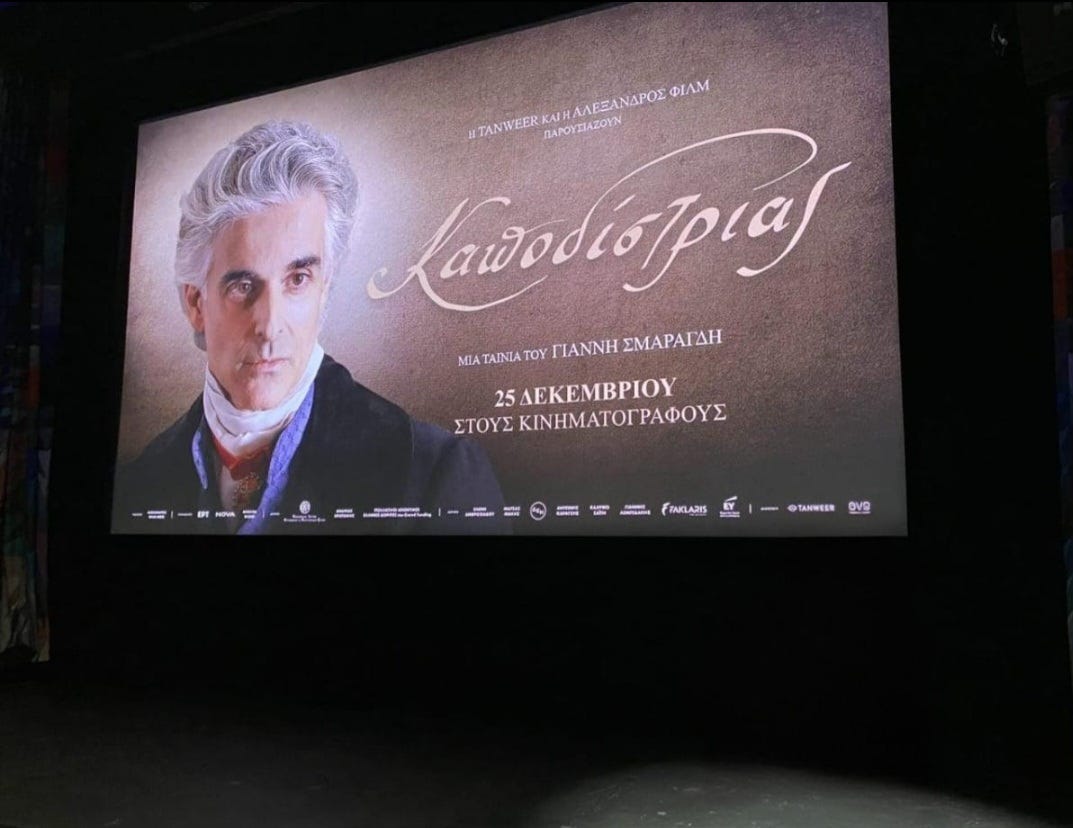
Some thoughts after watching Kapodistrias.
You can see that a great deal of money, effort and genuine affection went into the film. The locations, colours and costumes often capture the atmosphere of the period, and there is no doubting the sincerity behind the project or its desire to honour one of the founders of modern Greece. Unfortunately, there are also plenty of technical glitches and lapses of continuity, and at times the whole thing looks less like a historical epic and more like one of those rather awkward plays we used to do at Greek school. The dodgy wigs, moustaches and beards only add to the effect.
There is a strong element of hagiography running through the film, but it is often handled in a rather cartoonish way. The characters are not especially rounded, and there are few shades of grey. Metternich, in particular, comes across more as a caricature than a believable historical figure.
Like many patriotic epics, Kapodistrias participates in the making and retelling of nation-making myths. Kapodistrias did not found Switzerland. He was not the saviour of France or the founder of modern Europe. He didn't even endorse the Filiki Etairia to begin with, let alone found it! Historians have pointed out numerous inaccuracies and exaggerations.
History, and indeed the man himself, were more complicated than that. And yet perhaps that misses the point. The film is less concerned with history as it was than with the ideals that modern Greece tells itself about its origins.
Perhaps the film's deeper concern is not so much with history as it was, but with Greece as it might have been.
The repeated appearances of the Panagia were, for me, among the weaker elements. Instead of drawing on Orthodox iconography, we are presented with an elderly and rather Catholic-looking Virgin Mary, bathed in white light. Rather than adding spiritual depth, these scenes become distracting and only reinforce the saintly portrayal of Kapodistrias.
Ironically, one of the stronger elements of the film is the relationship between Kapodistrias and Roxandra. There was much more that could have been made of it, and it provided some welcome humanity amid all the speeches and historical exposition. Although, this again, diverges from the historical Capodistrias and builds the mythical Kapodistrias.
Yet beneath the dodgy facial hair and the occasionally cartoonish presentation lies a serious message. The film presents Kapodistrias as a man of education, democracy, equality and public service, with a vision not only for Greece but for Europe. It is striking how often the film returns to the importance of education and to the idea that everyone should contribute to the common good and pay their fair share of taxes. His ideals are contrasted with the narrow interests of the κοτζαμπάσηδες i.e. the robber barons and local power brokers, and with the interference of foreign powers pursuing their own interests.
One cannot help wondering whether the film is speaking as much about modern Greece as nineteenth-century Greece. The tensions it depicts, between reform and self-interest, between public service and private advantage, between European ideals and local factionalism, have hardly disappeared.
In the end, I found myself thinking less about what the film actually was and more about what it could have been. There are moments when one catches glimpses of the great historical epic it might have become, before the technical glitches, the cartoonish hagiography and the dodgy facial hair pull it back down to earth.
And then it struck me that perhaps this is fitting.
For that is also the question that hangs over Kapodistrias himself.
What if?
What if he had lived?
What if his vision of a Greece founded upon education, equality before the law, public service and civic virtue had prevailed? What if the new state had been built around institutions rather than interests, around the common good rather than the ambitions of the powerful? What if the robbery barons and the Great Powers had not frustrated his efforts?
Perhaps that is why the film has resonated with so many ordinary Greeks despite its obvious shortcomings. It is not simply asking what Greece was. It is asking what Greece might have been.
Despite its flaws, I'm glad I saw it, and I'm glad that a film about Ioannis Kapodistrias exists at all. For all its unevenness, it succeeds in reminding us that history is not inevitable.
Things might have been otherwise.
And perhaps that is Greece's great "what if?".